
You’ve decided to renovate. You’re excited about the new kitchen, the finished basement, the bathroom that finally works for your family. Then the work starts, and a different feeling shows up.
Dust on the counters. A fine grey film on your couch. Boot prints on the carpet. Plastic sheeting where a door used to be. You can’t cook dinner in your own kitchen. You keep the kids out of half the house.
Nobody warns you about this part. Every contractor talks about the finished photos. Almost none of them talk about what your house feels like on a random Tuesday, three weeks into the job. That’s the part we guarantee.
The Part of a Renovation Nobody Shows You
Renovation dust isn’t just an inconvenience. Drywall dust, sawdust, and old insulation particles are fine enough to travel through your whole house. They settle in air ducts. They land on food in the kitchen. They get tracked into rooms nowhere near the work.
For a family with young kids, allergies, or breathing issues, that’s not a small thing. And even without any health concerns, most people just don’t want to live inside a construction site for weeks at a time. So we treat this as part of the actual job, not an afterthought. It has its own plan before we ever start swinging a hammer.
Here’s the honest version: “we’ll keep it clean” is one of the most common promises in this industry, and one of the least specific. Ask any contractor how they’ll control dust and mess, and most will give you a shrug and a broom. We built a system instead.
What “Clean Job Site” Actually Means
A clean job site isn’t about a tidy pile of tools at the end of the day. It’s about controlling where dust and debris are allowed to go in the first place, and cleaning up what’s left before we walk out. For us, that comes down to two things working together: containment and cleanup. We separate the work area from the rest of your home, and we reset the space every single day.
“Clean job site” can mean almost anything, depending on who you ask. So here’s exactly what’s on every Cornerstone project, not a vague promise:
1. Sealed poly containment
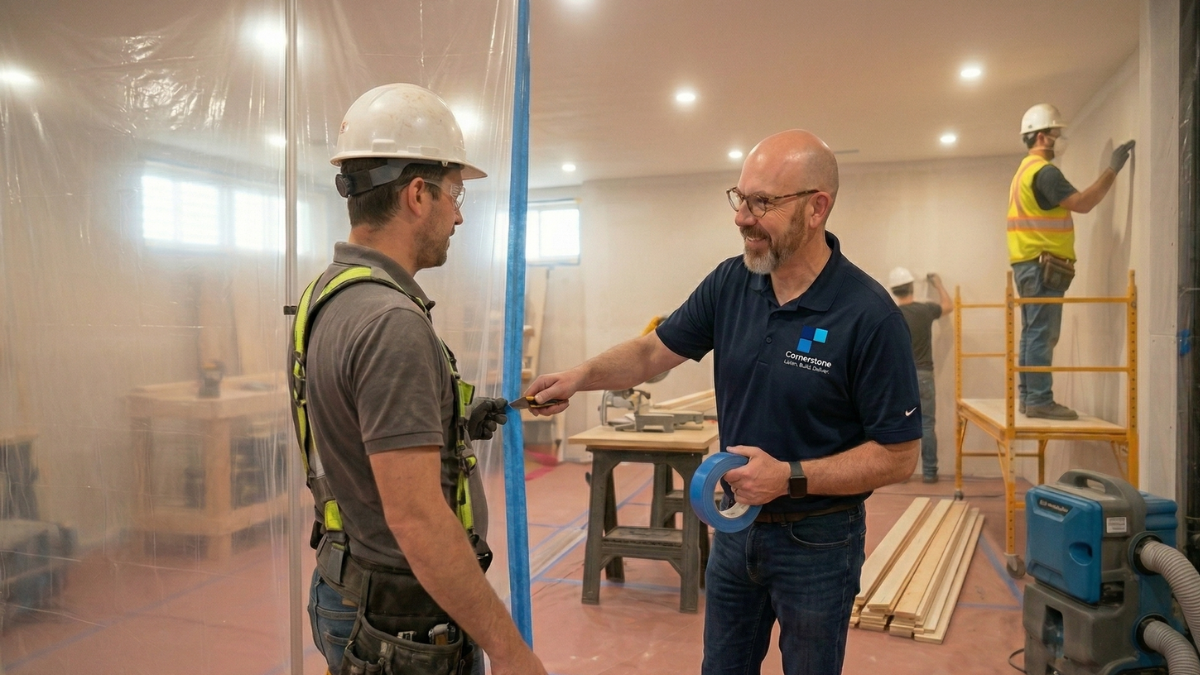
Sealed poly walls around the work zone, with zippered doorways so we can pass through without dust escaping every time.
2. Floor protection on every path
Guardia Pro floor protection laid down from the front door to the work area, so nothing gets scratched, scuffed, or ground with grit.
3. HEPA / negative air control
Air scrubbers or negative air pressure, sized to the job, actively controlling where dust in the air is allowed to go.
4. A daily reset
The work area gets cleared, wiped, and put back together before we leave — every day, not just on the last day of the project.
None of this is an upgrade you have to ask for. It’s the base standard on every job we run, big or small, part of the same process we follow on every project.
HEPA / Negative Air Protection
On larger jobs, we run HEPA air scrubbers. These pull air through a filter fine enough to trap the dust that regular sweeping can’t touch, and they keep the air in the work zone moving in one direction — away from the rest of your home.
On smaller jobs, we use negative air pressure instead. We pull dusty air out through a nearby door or window, so it’s leaving your home instead of settling into it. It’s a smaller-scale version of the same idea: control where the air goes, and the dust goes with it.
Either way, we combine that with sealed poly containment walls around the work area, floor protection on every path we walk through your home, and MERV-rated filters on your HVAC system so dust doesn’t get pulled into your ductwork and spread to the rest of the house. You can read the full breakdown on our HEPA and dust containment page.
Daily Cleanup — The Part That Keeps Your House Livable
Containment stops dust from spreading. Daily cleanup is what makes your house feel like a home again at the end of each day.
Before we leave a job site, the work area gets reset. Floors are cleared. Surfaces are wiped down. Tools and materials are put away, not left scattered where someone could trip over them.
Your kitchen counter isn’t buried in sawdust when you go to make dinner. That’s the standard, not the exception.
This matters most for the rooms you’re still using. If we’re renovating your basement but your kitchen and bedrooms are upstairs, those rooms should feel completely normal. That’s the actual goal — not just a clean job site, but a livable one. Full details are on our daily cleanup page.
Why Most Contractors Skip This
If sealed containment, air scrubbers, floor protection, and a daily reset are this straightforward, why doesn’t every contractor do it? Time and cost. Setting up proper containment takes time before the “real” work even starts. Running an air scrubber for the full length of a job costs money. A genuine daily reset takes longer than most crews are budgeted for.
So on a lot of jobs, it gets skipped — or done halfway:
- ❌ A sheet of plastic taped over a doorway isn’t containment
- ❌ A broom pass at 4:45pm isn’t a daily reset
- ❌ These shortcuts don’t show up on the quote — and they don’t show up in the finished photos either
But you’ll feel them every day the work is happening. We build the time and cost of doing this properly into every quote from the start. It’s part of the price you’re given, not something added on later.
What This Means for the Rest of Your Home
A renovation almost never touches only one room. Even a bathroom remodel means people walking through your hallway with tools and materials. A basement finish means trips up and down your stairs, past your kitchen, out your front door.
That’s why floor protection isn’t limited to the room being worked on. It covers the actual path — every hallway, every staircase, every doorway the crew uses to get in and out.
The goal: the only room that looks like a construction site is the one actually being renovated. Everywhere else should look, and feel, like nothing is happening at all.
How This Compares to a Typical Renovation
| What Happens | Typical Contractor | Cornerstone |
|---|---|---|
| Dust containment | ❌ Sometimes a loose sheet of plastic | ✅ Sealed poly walls with zippered doors, every job |
| Air filtration | ❌ Rarely mentioned | ✅ HEPA scrubbers or negative air, sized to the job |
| Floor protection | ❌ Cardboard, if anything | ✅ Guardia Pro protection on every walked path |
| End-of-day cleanup | ❌ Whatever gets swept before the truck leaves | ✅ Full daily reset of the work area |
| Who’s doing it | ❌ Whichever crew was sent that day | ✅ Mike, the owner, on-site |
Why This Is Part of Our Certainty Stack
Site protection isn’t a bonus feature we added to sound good. It’s one piece of the Certainty Stack — the full set of guarantees that come standard on every Cornerstone project, alongside our Price Lock Guarantee and On-Time Guarantee.
The idea behind all of it is the same: a renovation shouldn’t feel like a gamble. You shouldn’t have to hope your contractor keeps the price honest, finishes on schedule, or treats your home with respect while they’re in it. Those things should be guaranteed, in writing, before the job ever starts.
Most of the promises contractors make live only in a sales conversation — said once, on the phone or at your kitchen table, and never written down anywhere you can point back to. The Certainty Stack exists because we’d rather put those promises on paper than ask you to just trust us. Site protection is one guarantee out of several, and it’s treated with the same weight as the ones tied directly to your invoice.
Who’s Actually Doing the Work
Here’s something most companies won’t tell you: on a lot of renovations, the person who sold you the job isn’t the person doing it. You meet the owner, then a rotating crew of employees shows up to do the actual work.
On a Cornerstone project, the person setting up containment, running cleanup, and doing the work is Mike — the owner. Not a crew sent on his behalf. That’s not a marketing line, it’s how the company is built. When the person managing the site protection plan has 35 years in the trade and his own name on the door, it gets treated like it matters.
Frequently Asked Questions
❓ Will I still be able to live in my house during the renovation?
In almost every case, yes. Containment barriers keep the work area separate from the rest of your home, and daily cleanup keeps the spaces you’re using livable. We’ll walk through exactly what to expect for your specific project before work begins.
❓ What’s the difference between HEPA scrubbers and negative air pressure?
Both control where dusty air goes. HEPA scrubbers actively filter the air in the work zone through a fine filter. Negative air pressure pulls dusty air out of your home through a door or window. We use whichever fits the size and scope of your project.
❓ Do you clean up every single day, even on small jobs?
Yes. Daily cleanup isn’t reserved for large projects — it’s standard on every job we run, regardless of size.
❓ What if I have allergies or a family member with breathing concerns?
Tell us before the job starts. We can adjust the containment plan and filtration approach based on your household’s specific needs.
❓ What happens if the containment barrier gets damaged during the job?
We check and repair containment as part of the daily routine. It’s not something that gets set up once and forgotten for the rest of the project.
❓ Do I need to move furniture or pack up rooms before you start?
We’ll tell you exactly what to move ahead of time, based on your specific project. Floor and surface protection handles the rest — you shouldn’t need to empty rooms that aren’t part of the work.
❓ Is site protection included in every quote, or is it an upgrade?
It’s included. Containment, HEPA or negative air, floor protection, and daily cleanup are part of the standard scope on every project — not a separate line item you have to choose.
See It for Yourself
A renovation is a big disruption already. It shouldn’t feel bigger than it has to. That’s the whole point of site protection — a plan that keeps your home livable, backed by a company willing to put it in writing.
You don’t need to take our word for how this plays out on a real job. Ask about it directly at your consultation — how containment gets set up for your specific layout, which rooms stay untouched, what a typical day looks like from the moment we arrive to the moment we leave. A contractor who’s actually done this before should be able to answer in detail, not in generalities.
Want to See How We’ll Protect Your Home?
See the Full Site Protection Guarantee
Book a free consultation and we’ll walk you through exactly how we’ll keep your home livable during your renovation, guaranteed in writing.
Book Your Free Consultation