Renovation Contractor in Oshawa & Durham Region
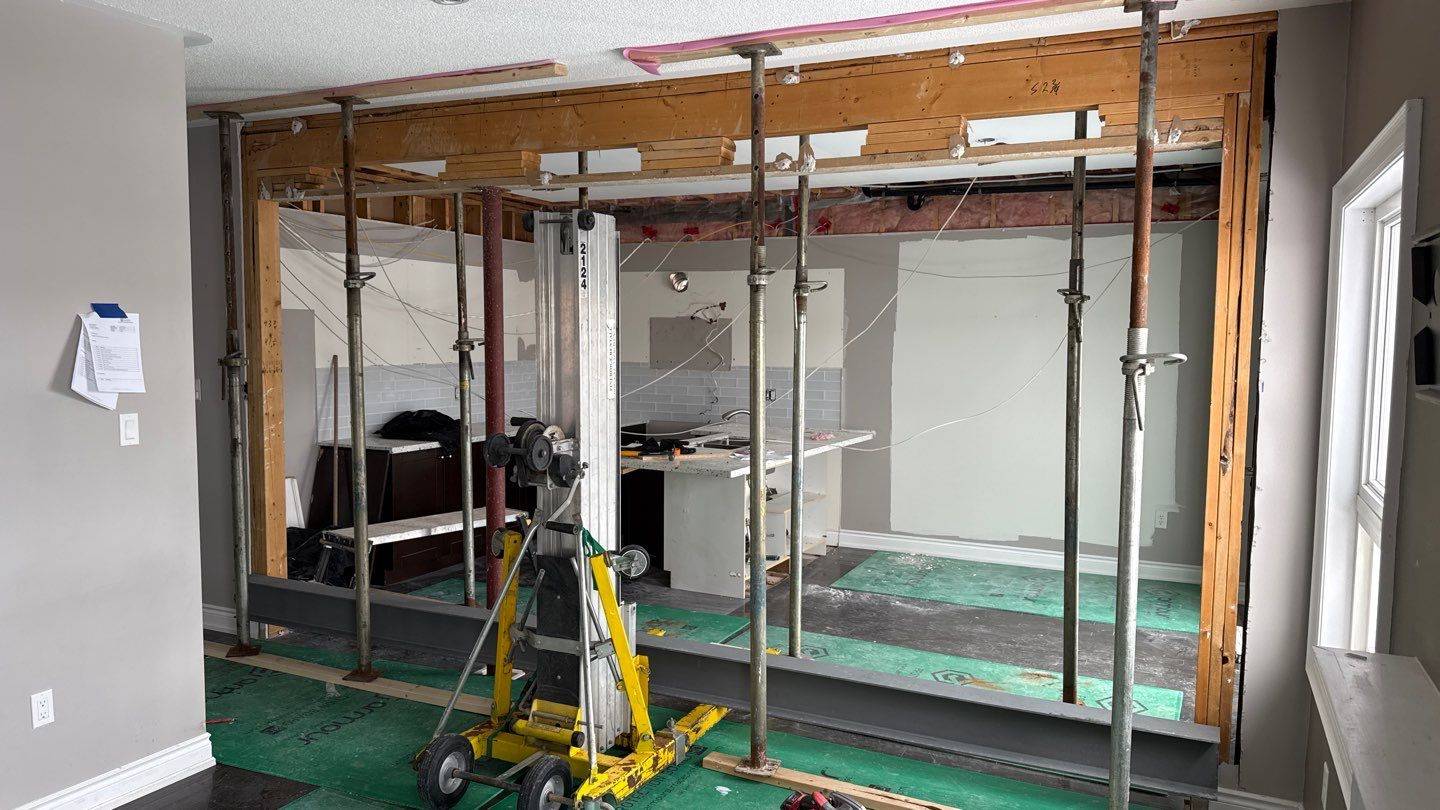
Open up your main floor the right way. Cornerstone removes load-bearing walls and installs engineered beams across Durham Region and the GTA — with stamped drawings, permits, and a fixed price, so the wall comes down safely and your home stays sound.
The Reason People Call
One wall is often all that stands between a closed-off, dated main floor and the bright, open kitchen-and-living space everyone wants. Taking it out connects the rooms, floods the space with light, opens up sightlines to the kids, and makes a home feel dramatically larger — without adding a single square foot.
It's one of the highest-impact renovations you can make to a home, and one of the best for resale. But it's also the one where what you can't see matters most. If that wall is holding up your house, removing it without the right beam and the right approvals isn't a renovation — it's a risk to your home and everyone in it.
First, The Big Question
Every wall is one of two things. Knowing which is the first step — and it's not always obvious from looking.
Carries weight from the roof, floors, or structure above and transfers it down to the foundation. You cannot simply remove it — a beam has to take over its job, sized by an engineer. This is the wall that needs the full process.
A non-structural divider that only separates rooms and holds nothing above it. It can usually come out without a beam — though plumbing, wiring, or ductwork hidden inside can still add scope. Simpler, but still worth confirming first.
Never assume. A wall that looks flimsy can be load-bearing, and a solid-looking wall can be a simple partition. We confirm exactly what a wall is doing — by reading the load path from the basement up — before anyone touches it.
Clues to Watch For
None of these confirm it on their own — only a proper assessment does — but if you notice any of them, treat the wall as load-bearing until it's checked.
These are starting clues, not a verdict. Homes get renovated, added onto, and re-framed over the years, so the only reliable answer comes from tracing the actual load path — which we do as the first step on every wall removal, before any plan or price is set.
The Beam Takes Over
When a load-bearing wall comes out, an engineered beam goes in to carry the weight the wall used to hold. The beam is sized by a structural engineer for your specific home, then supported on each end by posts that run down to proper footings — so the load has a clear, continuous path all the way to the foundation.
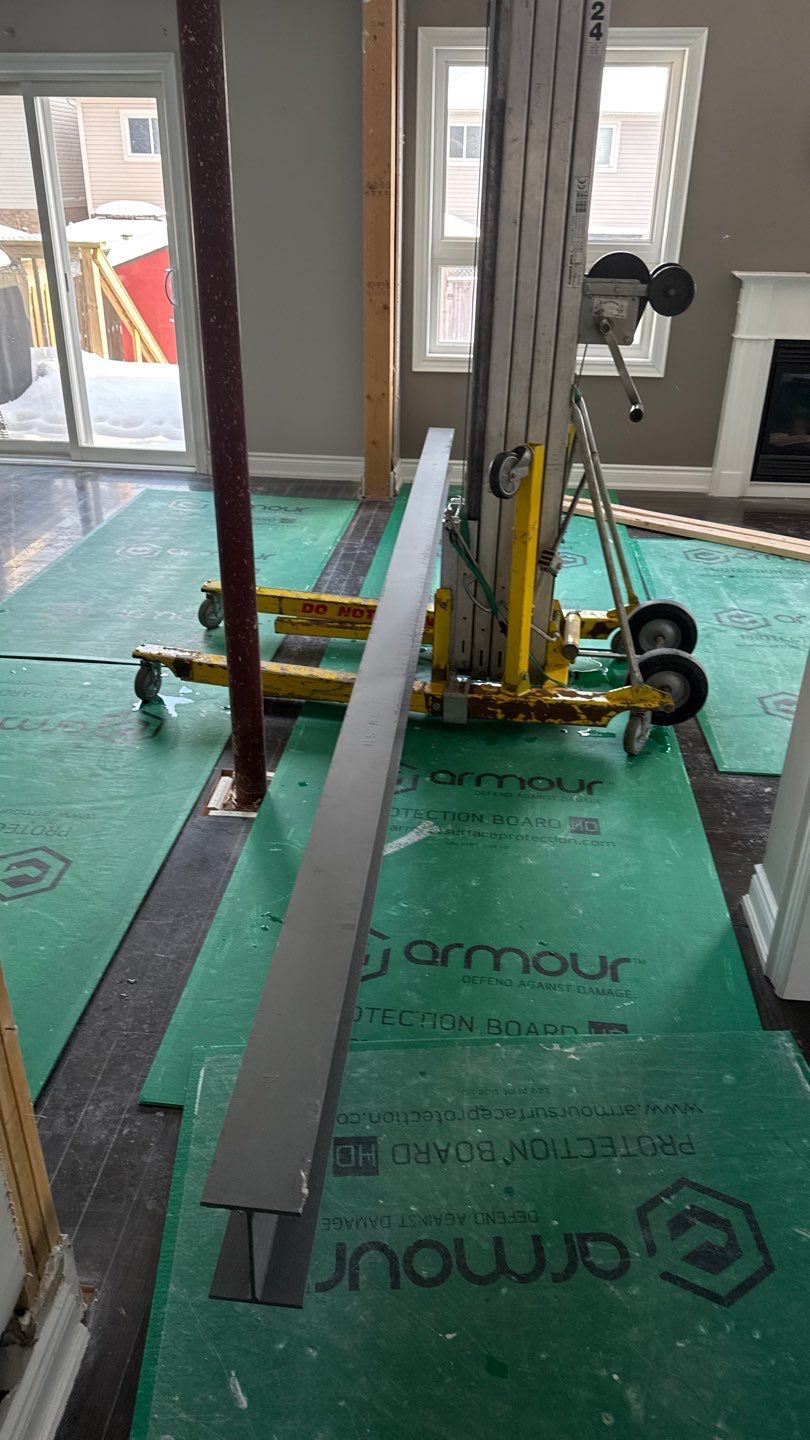
We use LVL (engineered wood) or steel beams depending on the span and the load. LVL is lighter, easier to handle, and well-suited to moderate spans; a steel beam is slimmer for the same strength and spans farther, which helps when ceiling depth is tight or the opening is wide. The engineer specifies which — you don't make that call alone. Before the wall comes out, we build temporary support on both sides to hold the structure while we work, so nothing above ever loses support for a moment. You can see a real steel-beam install in our Bowmanville whole-home renovation.
A Choice That Changes the Ceiling
Once you know a beam is needed, there are two ways to install it — and it changes how your finished ceiling looks.
The beam is tucked up inside the floor above, so the ceiling stays flat and smooth — the clean, fully open look most people want. It costs more, because the joists above have to be cut and re-hung off the new beam.
The beam hangs below the ceiling, visible as a band across the opening. Often faster and more affordable, since the beam sits below what's already there. Some homeowners even like it as a feature, wrapped in wood or trim.
Budget & Timeline
Every home is different, but here's the honest range for the three scenarios we see most. Your exact number comes after we read the load path and scope the finishing — and it's fixed in writing before any work starts.
Non-Structural
Partition Wall Removal
$500 – $2,500
Timeline: one day to about a week. No engineer or beam needed; cost climbs if plumbing, wiring, or ducting hidden inside has to be rerouted.
Load-Bearing
Drop Beam
$7,000 – $15,000
Timeline: roughly one to two weeks plus permit time. Includes the engineer, stamped drawings, permit, temporary shoring, and a visible beam across the opening.
Premium Finish
Load-Bearing — Flush Beam
$12,000 – $20,000+
Timeline: two to three weeks plus permit time. Joists are cut and re-hung off the beam for a completely flat ceiling — more labour, the cleanest result.
Ranges are typical Durham Region pricing for the structural work and standard finishing; wide openings, long spans, steel beams, or extensive finishing can run higher. Permit fees vary by municipality and are confirmed in your proposal. The figure you approve is the figure you pay — backed by our Price Lock Guarantee.
Why It Has to Be Done Right
Removing a load-bearing wall is structural work, and in Ontario that means it needs a building permit and engineered drawings. We handle both — a structural engineer sizes the beam and stamps the drawings, we pull the permit, and the work is inspected. That's not red tape; it's the proof your home is safe and the record that protects you.
Skipping it is where homeowners get burned — and the savings never turn out to be real. The risks below are exactly why we never cut that corner, on any job.

The Real Cost of Cutting Corners
A contractor who removes a load-bearing wall without a permit and stamped drawings isn't saving you money — they're handing you a liability that can surface years later, at the worst possible time.
An undisclosed structural change is a material change to your home. If a claim ever traces back to unpermitted work — a sag, a crack, a collapse, even an unrelated loss — an insurer can have grounds to reduce or deny it. Permitted, inspected work keeps your coverage clean.
Unpermitted structural work routinely surfaces in a buyer's home inspection or a title/permit search. It can stall the deal, drop your price, or force you to open the wall back up and retro-permit it to prove it was done right — on the buyer's timeline, not yours.
Without stamped drawings, there's no engineer standing behind the beam size and no inspection confirming the work. If the structure ever moves or fails, that exposure lands on you as the homeowner — not the contractor who's long gone.
Building without a required permit can trigger a stop-work order or an order to uncover and correct the work after the fact — meaning the finished wall, ceiling, and flooring come back off so the structure can be inspected. The cheap route becomes the expensive one.
We pull the permit and provide stamped engineered drawings on every load-bearing removal — so the work is safe, inspected, and documented, and your home, your coverage, and your resale stay protected. Always confirm current permit requirements for your project with your municipal building department; we handle that for you on every job.
How We Build It
We confirm whether the wall is load-bearing by reading the structure from the basement up — beams, posts, and how the load travels to the foundation — so we know exactly what the wall is doing before we plan a thing.
A structural engineer sizes the beam and produces stamped drawings. We pull the building permit and schedule the inspections. You get a fixed-price proposal before any work begins.
We build temporary shoring on both sides of the wall to carry the load safely, so the structure above is never left unsupported during the work.
The wall comes out and the engineered LVL or steel beam goes in, set on posts that carry down to proper footings — flush or drop, as you've chosen.
The structural work is inspected and signed off, then we close everything up — drywall, ceiling, flooring, and finishes — so the only thing you see is the open space you wanted.
The Upside
Open-concept main floors are still what most buyers are looking for, which is why removing the right wall tends to return well at sale. It modernizes a dated layout, makes the whole floor feel larger and brighter, and photographs far better in a listing — all without the cost of an addition. You're not adding square footage; you're making the square footage you already have feel like more.
The catch is that the value only counts when the work is permitted and documented. A clean permit history and stamped drawings turn the renovation into a verifiable improvement a buyer and their inspector can trust. The same job done without paperwork becomes a question mark that works against you at exactly the moment you're trying to sell. Done right, it's an asset on the listing — see a real before-and-after in our open-concept wall removal in Whitby.
What to Expect
Cost depends on the span, whether you choose a flush or drop beam, an LVL versus steel beam, and how much finishing follows. Engineering and permits are part of the scope, not a surprise. You get a fixed price in writing before any work begins.
Structural work runs on a committed schedule with a defined start and end date, backed by our $300/day on-time guarantee. You know when the wall comes out and when your open space is finished.
Engineer, permits, demolition, structural beam, electrical and plumbing re-routes, drywall, and finishing — all handled under one contract. No juggling trades, no gaps where things fall through.
Sealed dust containment, HEPA air scrubbers, floor protection, and a daily cleanup — structural demolition is messy, so we collect it at the point of cut before it spreads through your home.
We remove walls and install beams across Oshawa, Whitby, Ajax, Pickering, Bowmanville, Courtice, Clarington, Uxbridge, and the broader GTA.
Common Questions
Start with a free project diagnostic. We'll assess whether your wall is load-bearing, walk you through the beam and the options, and deliver a detailed proposal with a fixed price — engineering and permits included — before any work begins.
Durham Region's trusted renovation contractor. Led by Mike Brock since 2017. We Listen, We Build, We Deliver.